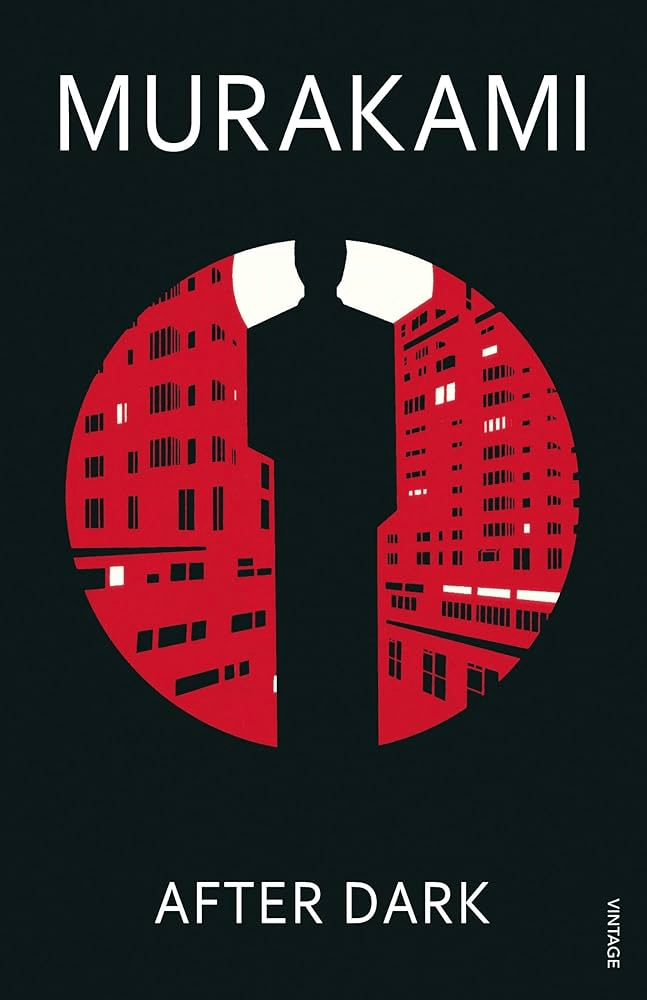
Dualism is when Haruki Murakami displays two things as mirroring each other, almost a reverse of what’s happening but at the same time sharing a commonality even if they are opposing ends of the thing, for instance male and female are both genders but opposite. In After Dark to separate certain aspects. For instance, Eri sleeping on the bed in the real world and the room inside of the television are, “two sides represent the realistic and the fantastic world”1. This theme repeats with Mari looking into the mirror and how mirror Mari stares back, even while, “Mari is no longer here”2. It is the idea of the dream world and the living and that’s represented in Mari and her sister: one is always asleep, and one is unable to sleep due to this. The awake and the asleep world is not the only way the theme of dualism is explored. It’s explored through Haruki’s characters in the novel in the way they act and how it changes whether it’s night or day. Actions taken during the night are usually ones that make the night more dangerous and the reverse for the day. This can be seen most clearly in when the phone is left in the shop and people pick it up. The dark underbelly of the crime world comes into stark contrast to everyday life, lit up under the lights of the shop. The shop is also an illustration of how Murakami subverts the trope of dualism, instead of having them rigid he makes the worlds collide, Mari falling asleep while her sister is asleep and the phone call in the shop.
The dream world is one that’s always around in After Dark for instance the way that it’s Eri’s “extreme disassociation from others”3 that leads her to sleep but Mari’s coping mechanism is to force herself to stay with others. She may be distant by hiding behind her book but for most of the story she’s communicating with people and changing location. This connection to the world is what leads her to the Love Ho, it’s a driving factor in the narrative as we follow her around. On the other end of this Eri’s refusal to engage with the world and the way she cuts off ties and wakes up in the television in this way solidifying her role as the sister stuck in the dreaming world. Eri doesn’t see this dreaming as a problem though, thinking that if she fell asleep, she would “wake up in [her] old reality”. (Murakami p45) This thought itself shows how far she’s drifted from reality. On the other side Mari is drifting too, she’s planning on moving to Beijing, away from Japan and away from her sister. The duality of moving away in the living world and moving away in the dreaming world is one that drives home for the reader how separate the sisters really are.
The separation between the sisters started at an early age. Eri was different, always being a “young, beautiful woman” (Murakami p15) but her and Mari was never given the same kind of attention in that area, instead being pushed to be smart. Eri and Mari mirror each other in the way they’re pushed into their roles in life. The way the roles of model and genius oppose each other push the sisters away from each other. They oppose each other to become what their parents want, “the elder sister, Snow White; the younger sister, a little genius” (Murakami p26) This starts when they’re quite young and when they become trapped in the lift the reader sees again how different they are, Mari going Silent while Eri takes control, two opposing sides and yet they, “became one” (Murakami p72) in that lift. This is because, throughout their different experiences, their differences in looks and beliefs they have the same feelings. They are foil characters.
The night and day are another good example of duality. At first glance the novel seems to be displaying the differences between night and day, as night in Tokyo is a “zone of omnipresent and imminent danger”4 whereas in the day Tokyo is, “mosaic where various activities take place” (Otomo) a beautiful place to be. I disagree with the idea that it’s just night and day, however I believe it’s more safety and danger, usually displayed by the darkness of the night and the brightness of the day. Night is unfamiliar, it’s a world that most readers have never explored. After Dark shows it to be a crime ridden world, where prostitutes get beaten up and taken away, back to gangs to continue being prostitutes. The night is shown to be an inescapable thing, once you’re stuck there not even sleep can fully remove you from there. This is a stark difference from the day Mari was reading her book in the day where Koenji annoys her. There is nothing darker at play, unlike in the night where there’s always mystery. The wat night is portrayed gives the reader a sense of unease while it’s dark. They know it’s a world removed from ours and within that it opens up space for the unknown.
The darkness houses outsiders, unlike the mundanity of the day. People do not belong out at night and therefore anyone who is awake is intruding on what could be the quiet of the night. This idea of anything intruding being the outsider. The concept of being an outsider is almost synonymous with the concept of danger. While this is a problematic way of thinking as it can create an ideology of, “insiders-are-secure’ and “outsiders are dangerous”5 which Fuminobu Murakami warns against writing in literature as it can create that attitude in the real world. I agree with this to a certain extent but when the main character and the audience themselves are the outsider, the rejected thing makes for a more compelling narrative. You know that being the outsider is dangerous, so you feel concern for the characters. This is subverted though, when Mari sees the prostitute, she’s an outsider to the prostitute’s world and she’s safer for it. The gang she’s with wasn’t able to keep her safe but Mari has the autonomy to keep herself safe. Despite being an outsider, her choice to stay awake saves her from dreaming her way out of reality, her choice to stay in populated areas and the fact she stays with people she knows to be safe most if the time shields her from the dark underbelly. The line between ‘outsider’ and ‘belonging’ is blurring.
Another duo that should be mentioned is Eri and the man watching her. The dualism comes from the way the man seems to be from another world and aware while Eri is from this world and, for the most part, unaware of what’s going on. “The Man with No Face is still sitting in the chair. Brown suit, black shoes, white dust, glossy mask adhering to his face.” (Murakami p37) Is aware of what’s going on and from the way that he’s described we know little about him. He seems to know more than us and has some kind of control. As Eri begins to fade in the tv the reader is prompted to wonder about him. This level of control he’s hinted to have been the opposition to Eri’s lack of control. “The man’s dressing is similar to that of Shirakawa”6 implying that someone like Shirakawa hurt Eri and how her modelling career may be the culprit.
While I like the aforementioned theory, I find myself in disagreement. Throughout After Dark it’s implied that there’s a greater power at play. I don’t believe that Eri’s dream sequence is just a dream sequence. If it was, how would the reader partake in it and why would she be dreaming of herself asleep most of the time? I find myself seeing a darkness controlling the city in the way that Shirakawa believes that he has been forced into acting this way by a high-pressure job and Eri has been pushed out of a normal life by her beauty. They both seemingly have no autonomy in the matter. Mari also claims to have no autonomy, saying that she can’t sleep, that she has to stay out of the house. The faceless person we see with Eri is only a personification of these things coming together.
“The uncanny combines these two semantic levels: its signification lies precisely in this dualism. It uncovers what is hidden, and by doing so, effects a disturbing transformation of the familiar into the unfamiliar”7 Murakami does this in the hidden parts to his stories. For instance, you never know who’s on the phone in the shop. On the opposing side to this however Murakami subverts the trope of duality and this feeling by having the abandoned phone in the shop. It’s threatening to have a piece of the crime life and scary to the characters that come across it but there’s also an innate hilarity to someone giving such serious threats but calling the wrong number. It immediately undermines any authority the threatening person holds as they can’t even get who they’re threatening right. The way Murakami subverts this trope gives autonomy to the reader. It means the story can be read as light-hearted or it can be read as dark, just like Eri could have been assaulted by Shirakawa or gone to the Love Ho with someone completely different and has a fine time. It’s for the reader to decide.
The trope is also more intentionally subverted at the end. Mari falling asleep by Eri. The sisters once again united and not trapped in their stark roles of mirroring each other, living in a world the other can’t have. Just like Mary Poppins, “is everything but a traditional old woman”8 while at the same time fitting into the trope of on old woman taking care of the children. Mari is portrayed to be the exact opposite of her sister when in reality she’s everything but the opposite. While Mari may not be beautiful many characters comment on how pretty she is while on the other hand Eri is not supposed to be the genius, but she shows signs of intelligence. Things in her room are placed so as to, “cleverly elude observing eyes” (Murakami p15) showing how she is in fact intelligent. The sisters possess trait most people spend time working for, the brains and the beauty. The way they both have this work ethic makes them very much alike.
The theme of subverting the duality between the characters started very early on, Eri distancing herself from the word is the same as Mari’s attempts to distance herself by travelling further and further away, making plans to move away to Beijing. Then at the end when she sleeps with her sister, she finally syncs up with her, finally finding peace at being by her side, at doing something so normal for people to do. Try to be like her older sister. Safety and danger colliding in the shop and in Eri’s room, but both end up still being safe. There’s an undertone here to reaching out to people, how having a connection with those around you can prevent bad things from happening. On the other side, in places where duality is not subverted, Shirakawa and his wife for instance, no longer meeting becoming like night and day this exposure to the night makes Shirakawa become dangerous and the day keeping his wife mundane, the biggest problem we know about his her missing her husband. The way characters’ relationships and tie in with each other is what drives the story onwards, it’s the characters motivations. The story never takes a stance on this but seems to be trying to leave us with the message that we can take control ourselves, subvert the roles we are put into and reach out to those around us, saving ourselves and others from what could be a dark path.
1 Elisabeth Weber, An Analysis of Afterdark by Haruki Murakami, (2009), (p23), <https://jochenenglish.de/misc/weber_afterdark.pdf>, accessed 05/05/2023
2 Haruki Murakami, After Dark, (Vintage Digital 2011), (p29)
3 Barbara Greene, Alienation and After Dark, Taylor and Francis online (2020), <https://doi.org/10.1080/00111619.2020.1777079>, accessed 05/05/2023
4Rio Otomo, Risk and Home: After Dark by Murakami Haruki, Taylor and Francis online, (2009), < https://doi.org/10.1080/10371390903298045 >, [accessed 05/05/2023]
5 Murakami, Fuminobu, Postmodern, Feminist and Postcolonial Currents in Contemporary Japanese Culture A Reading of Murakami Haruki, Yoshimoto Banana, Yoshimoto Takaaki and Karatani Kojin, Taylor & Francis (2006), (p5)
6 Swagatika Panda, Murakami’s After Dark: Female Representation and Transition, IJEMHS (2019), (p3), <https://www.ijemhs.com/Published%20Paper/Volume%2031/Issue%2003/IJES%2031/IJEMHS_Q3_2019_APM_265_269.pdf>, accessed 05/05/2023
7Rosemary Jackson, Fantasy: The Literature of Subversion, London: Routledge. (1988), (p 65)
8 Auba Llompart, Lydia Brugué, Contemporary Fairy-Tale Magic Subverting Gender and Genre, Brill (2020), (p232)
Bibliography
Auba Llompart, Lydia Brugué, Contemporary Fairy-Tale Magic Subverting Gender and Genre, Brill (2020)
Fuminobu Murakami, Postmodern, Feminist and Postcolonial Currents in Contemporary Japanese Culture A Reading of Murakami Haruki, Yoshimoto Banana, Yoshimoto Takaaki and Karatani Kojin, Taylor & Francis (2006)
Greene, Barbara, Alienation and After Dark, Taylor and Francis online (2020), <https://doi.org/10.1080/00111619.2020.1777079>. [accessed 05/05/2023]
Jackson, Rosemary, Fantasy: The Literature of Subversion, London: Routledge. (1988)
Murakami, Haruki, After Dark, (Vintage Digital 2011)
Otomo, Rio, Risk and Home: After Dark by Murakami Haruki, Taylor and Francis online, (2009), <https://doi.org/10.1080/10371390903298045>, accessed 05/05/2023
Swagatika Panda, Murakami’s After Dark: Female Representation and Transition, IJEMHS (2019) <https://www.ijemhs.com/Published%20Paper/Volume%2031/Issue%2003/IJES%2031/IJEMHS_Q3_2019_APM_265_269.pdf>, accessed 05/05/2023
Weber, Elisabeth, An Analysis of Afterdark by Haruki Murakami, (2009), <https://jochenenglish.de/misc/weber_afterdark.pdf>, accessed 04/05/2023
 Earnest Thoughts
Leave a comment