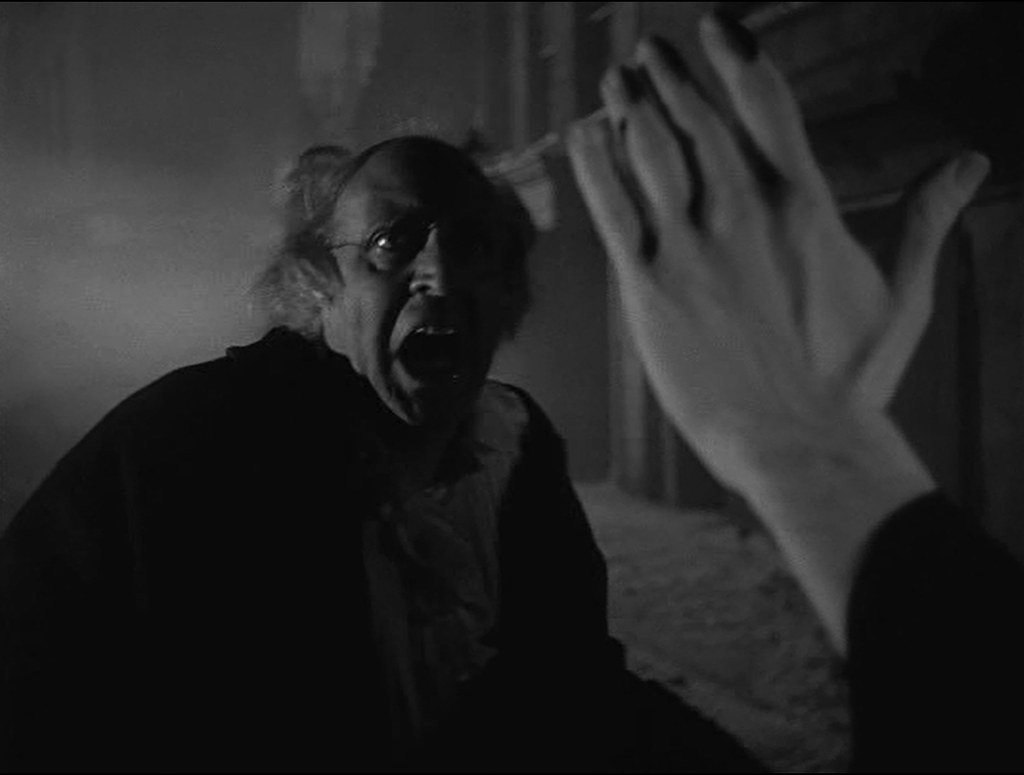
Characterisation in a Christmas Carol is what makes the work so timeless. In my own work, I aimed to save the core of Scrooge’s character but change his motivation to kindness. This challenges the idea that Scrooge must act kinder to solve his problems.
In A Christmas Carol, Scrooge is portrayed as, “stingy, cold, abusive, uncaring, cruel, lonely and obsessed with money.”[1] This works as a tool within the novella to accentuate how abhorrent Scrooge is to the people around him and how desperately he needs to change. I kept some aspects, giving Scrooge room to develop but changed others. Instead of writing Scrooge as abusive, I wrote him as well meaning, he tries to be nice but is let down by his stinginess and those around him. I turned his virtues into vices, the fact he is “good in business” (Klontz and Kahler pXIX) meant those around him were vying for his fortune. Scrooge tries to be nice but his unwillingness to share and reputation for owning a successful business makes the people around him resentful. That is what isolates him. A fact Scrooge is not aware of (in my version) until the spirits visit him. My changed version of Scrooge removed some of the blame from him. His unwillingness to change comes from the futility of trying. This turns Scrooge from miserable caricature into someone trying his best. It also adds a sense of reality and relatability to the story.
In Some Christmas Thoughts On Ebenezer Scrooge by Thomas Storck he compares Scrooge’s work ethic with the protestant work ethic (redemption is earnt through work. It should be valued above personal enjoyment) saying that it’s, “well embodied”[2] by Scrooge. This backs up my claim that his business mind is indeed a virtue. The way he acts at the start of A Christmas Carol he is already well on his way to redemption, through his work according to the protestant work ethic. Charles Dickens’ work takes on a more utilitarian approach, arguing everyone is worthy. I decided to show Scrooge’s work ethic as the right thing to do and shamed both Bob Cratchit and Tiny Tim for not sharing the same goals. In my piece Scrooge points out that it is Cratchit’s own choice to have such a large family he can barely provide for them. It recharacterizes Cratchit as a careless rather than loving father. Scrooge ended up sacrificing family and his loved ones happiness for his work. I do not however agree that the protestant work ethic is the right way to go about things. It does not help poverty and belittles those who are unable or unwilling to work. In this I added Scrooge being reasonable but unwilling to change. The Spirit told him Bob Cratchit needs a pay rise, so that he may have a liveable wage and Scrooge accepts.
One of the key factors that lets scrooge down is not himself but the people around Scrooge. The main let down is Scrooge’s nephew, Fred. In A Christmas Carol he, “represents the real spirit of Christmas”[3] with his joy and good will, even in the face of Scrooge. He is the person that Scrooge should aspire to be, he has a loving wife and friends. He may not have the same wealth as Scrooge, but he is loved and determined to share it. No matter how miserable Scrooge is towards him. In my piece I decided to characterise him completely differently. He’s now helpless with money, the relationships built in the past are now inconsequential. He’s alone. This was written because it’s a very real situation. People who are unable to get a good grasp on money could end up destitute through carelessness. Like the original novella. Fred still provides the, “antithesis to his dark and frozen uncle” (Waldron and Buckroyd p36) but instead of being, “warm and glowing” (Waldron and Buckroyd p36) he’s a burden to those around him and a worry to Scrooge. Although he does not speak. just seeing Fred is enough to bring Scrooge to tears. It provides a sort of opposition to love, which is not enough to save Fred. There is no way to save Fred. but Scrooge allowing him to suffer is also wrong as humanity is meant to be Scrooge’s business.
Another Character that changed is the, Ghost of Christmas Yet to Come. In A Christmas Carol and many of its adaptations the spirit is terrifying. The costume in The Man Who Invented Christmas is on display in the exhibit Ghost of an Idea: Unwrapping A Christmas Carol the costume was put on display and described to be, “unexpectedly huge and frightening”[4]. The costume personifies the Phantom exactly. As it doesn’t speak in the novella it’s the look and feel of the Spirit that characterises it. “The ghost’s silence forces Scrooge into an increasingly frantic interrogatory position”[5] It only leaves Scrooge with his doubt giving the reader a chance to watch Scrooge’s growth in real time. I undermined all that. The spirit, although reacted to as if it is scary. actually appears to be wearing a modern-day ghost costume (a sheet with eye holes cut in). This immediately undermines the original of the spirit someone may have in their mind when reading my work. It recharacterises it immediately as a laughable being. The Spirit talks as if it is above Scrooge too, calling Scrooge, “arrogant” for asking questions. Its aloofness, always talking but never offering answers, unlike its original counterpart, creates a frustrating being. One that tells Scrooge to do better without ever really telling him how. This reflects modern day society; the way people are always told to do better and be kinder but the fact is that wont solve the problems that are already out there. The simplicity but uselessness of the Spirit telling Scrooge to change shows that there are rarely simple answers.
A Christmas Carol is created to make people reflect on their own morals around Christmastime and how they should hold it throughout the year. In my version the way the characters act and situations they are placed in draws attention to the fact that solutions are rarely black and white.
[1] Ted Klontz and Rich Kahle, The Financial Wisdom of Ebenezer Scrooge, (Deerfield Beach, Florida: Health Communications, Incorporated, 2005)pXIX
[2] Thomas Storck, Some Christmas Thoughts On Ebenezer Scrooge in The Distributist Review, (2016) <https://distributistreview.com/archive/christmas-thoughts-ebenezer-scrooge> [accessed 23 December 2022]
[3] Carmel Waldron and Peter Buckroyd, Oxford Literature Companions: A Christmas Carol, (Oxford: OUP Oxford 2015) p36
[4] Jenny Hartley, The Man Who Invented Christmas, (2018), <https://www.proquest.com/docview/2056426012?fromopenview=true&pq-origsite=gscholar> [accessed 23 December 2022]
[5] Brandon Chitwood, Eternal returns: A Christmas Carol’s Ghosts Of Repetition, (2015), < https://www.cambridge.org/core/journals/victorian-literature-and-culture/article/eternal-returns-a-christmas-carols-ghosts-of-repetition/587C67E0FE3450B2BB6424322A5F04BD> [accessed 23 December 2022]
Chitwood, Brandon, Eternal returns: A Christmas Carol’s Ghosts Of Repetition, (2015), <https://www.cambridge.org/core/journals/victorian-literature-and-culture/article/eternal-returns-a-christmas-carols-ghosts-of-repetition/587C67E0FE3450B2BB6424322A5F04BD> [accessed 23 December 2022]
Hartley, Jenny, The Man Who Invented Christmas, (2018), <https://www.proquest.com/docview/2056426012?fromopenview=true&pq-origsite=gscholar> [accessed 23 December 2022]
Klontz, Ted and Kahle, Rich, The Financial Wisdom of Ebenezer Scrooge, (Deerfield Beach, Florida: Health Communications, Incorporated, 2005)
Storck, Thomas, Some Christmas Thoughts On Ebenezer Scrooge in The Distributist Review, (2016) <https://distributistreview.com/archive/christmas-thoughts-ebenezer-scrooge> [accessed 23 December 2022]
Waldron, Carmel and Buckroyd, Peter, Oxford Literature Companions: A Christmas Carol, (Oxford: OUP Oxford 2015)
 Earnest Thoughts
Leave a comment